
Update from the Police and Crime Commissioner... Safer Countryside: Practical Support for Our Rural Communities

|
||
|
|
||
|
||
|
Update from the Police and Crime Commissioner... Safer Countryside: Practical Support for Our Rural Communities |
||
|
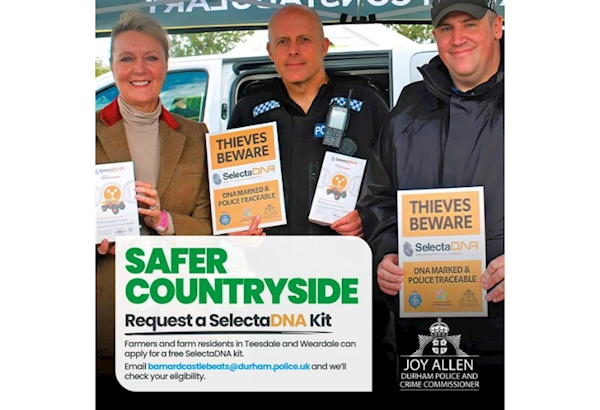
Living and working in our countryside should not mean accepting a greater risk of crime, isolation or harm. Our rural communities are a vital part of County Durham, and I am determined that farmers, families and businesses receive the same focus on prevention, protection and reassurance as anywhere else. That is why I continue to invest in practical and targeted Safer Countryside initiatives, not simply responding when something goes wrong, but preventing crime and harm in the first place. This has included funding ‘Stop Me’ trailer stickers, drones and alarms, alongside high-visibility ‘Wide and Slow’ jackets to protect horse riders and remind motorists to pass safely. I have also supported the Herbert Protocol and Dementia Wristband initiative, funding bright yellow wristbands containing next-of-kin contact information to help people living with dementia who become lost or confused to be reunited with their families more quickly. We are investing in water safety too. I have contributed towards throw ropes for police vehicles alongside Durham University and the City of Durham Parish Council, following specialist training delivered by County Durham and Darlington Fire and Rescue Service. Our latest initiative is aimed directly at protecting farming communities. Working with Durham Constabulary, local councillors, Durham County Council's local networks, the Crook North and Tow Law Pride in Place Board and Wolsingham Show, we have funded a pilot providing SelectaDNA forensic property-marking kits to eligible farmers in Teesdale and Weardale. It is a great example of partners pooling resources and match funding practical crime prevention measures for rural residents. Each kit is uniquely registered to its owner and can be used to mark up to 50 items, including tools, machinery and valuable equipment. If marked property is stolen and later recovered, police can identify the owner and help return it. Visible forensic marking also acts as a deterrent, making equipment less attractive to criminals. Our recent Rural Crime Week demonstrated why prevention and partnership matter. Officers recovered stolen vehicles and equipment, made arrests and worked alongside neighbouring forces, partner agencies and Rurali volunteers through Operation Checkpoint to disrupt criminals operating across force boundaries. This is the approach I want to see: prevention, intelligence, technology, enforcement and strong rural partnerships working together to keep communities safe. Creating a safer countryside is about more than tackling theft. It means protecting vulnerable residents, improving road and water safety, supporting farmers and ensuring people living in isolated communities know they have not been forgotten. To those who think our countryside provides an easy target for crime: it does not. Our officers, volunteers, partners and communities are working together to make rural crime harder to commit and easier to detect. Officers and staff have recently been promoting the SelectaDNA scheme and wider rural crime prevention advice at agricultural shows in Stanhope, Wolsingham and Eggleston. If you are a farmer or farm resident in Teesdale or Weardale and would like to request a kit, please email barnardcastlebeats@durham.police.uk. The team will check your eligibility and provide further information. Together we are making our communities safer, stronger and more resilient to crime and anti-social behaviour.
| ||
Reply to this message | ||
|

|