|
Here’s a quick update on drugs dealing crime in your area, please be reassured that we’re taking this seriously and are here to help. Dear Colville Residents,
Your local Safer Neighbourhood Team continues to receive reports relating to suspected drug activity, anti-social behaviour and nuisance across the ward. This is one of the ward priorities.
A question I am often asked is, "Why can't the Police just close an address down?" The reality is that obtaining a Closure Order is a significant legal power which requires robust evidence and careful consideration by the courts.
Before pursuing a Closure Order, Police work closely with RBKC, housing providers and partner agencies to understand what is happening at a property. We must consider whether individuals are involved in criminality, whether there are vulnerabilities such as mental health concerns, substance misuse issues or exploitation, and whether support can be provided to help address the behaviour.
Our aim is always to strike the right balance between protecting the wider community and ensuring vulnerable people receive appropriate support.
So far this year, I have attended court several times in relation to three separate addresses within Colville Ward. Sadly, in those cases the individuals concerned were not engaging with support services or willing to work with Police and partner agencies to address the issues occurring at the properties.
On two occasions, Partial Closure Orders were initially sought and granted in an attempt to balance the needs of the community with the circumstances of those living at the address. However, despite these measures, the anti-social behaviour and criminality continued. As a result, I had to return to court and apply for Full Closure Orders, which were subsequently granted.
For a Magistrates' Court to grant a Closure Order, it must be satisfied that one or more of the following apply:
• Disorderly, offensive or criminal behaviour has occurred, or is likely to occur, at the premises.
• The use of the premises has caused, or is likely to cause, serious nuisance to members of the public.
• The use of the premises has caused, or is likely to cause, disorder in the vicinity of the premises.
The court must also be satisfied that a Closure Order is necessary to prevent the behaviour from continuing or recurring.
Whilst police reports, intelligence and incident logs are important, information from local residents can be crucial. Residents often have concerns about being identified; however, in many cases we can rely on hearsay evidence, meaning information can be presented anonymously within court documents and referred to as Person A, Person B or Person C, without identifying the individual providing the information.
We are also mindful of cuckooing, which is a form of criminal exploitation. Cuckooing occurs when criminals, often involved in drug dealing, take over the home of a vulnerable person and use it as a base for criminal activity. This may involve storing or supplying drugs, harbouring offenders, or using the property to facilitate further criminality.
People who are vulnerable due to mental health issues, physical health conditions, learning difficulties, isolation, alcohol dependency or drug misuse can be particularly at risk. In some cases, drug users themselves are exploited by dealers who provide drugs, money or companionship in exchange for access to their home. What may initially appear to be a problem address can sometimes be the home of a vulnerable person who is being controlled or exploited by others.
Signs of cuckooing can include:
• Frequent visitors attending all hours of the day and night.
• Short-stay visitors.
• Increased drug-related activity.
• Unknown individuals appearing to live at the address.
• The occupier becoming withdrawn, fearful or isolated.
• Increased anti-social behaviour linked to the property.
This is why every address must be carefully assessed before enforcement action is taken. Where possible, we will seek to safeguard vulnerable individuals and help them access support services. However, where criminality and nuisance continue and the community is suffering as a result, we will take robust action to protect residents.
The types of information that help us build evidence include:
• Frequent short-stay visitors.
• Suspected drug dealing or drug use.
• Suspicious comings and goings.
• Noise nuisance and anti-social behaviour.
• Intimidation or harassment.
• The impact the behaviour is having on residents and the wider community.
If you are witnessing activity that concerns you, all I need is a brief email through Met Engage outlining:
• What you have seen.
• Dates and times.
• Descriptions of people or vehicles involved.
• How the activity is affecting you or the community.
Even small pieces of information can help build an intelligence picture and support future enforcement action.
Thank you to everyone who continues to report concerns and support your local policing team. By working together, we can continue to build a safer and stronger Colville community.
PC Dawn Baxter
Colville Safer Neighbourhood Team
Metropolitan Police Service
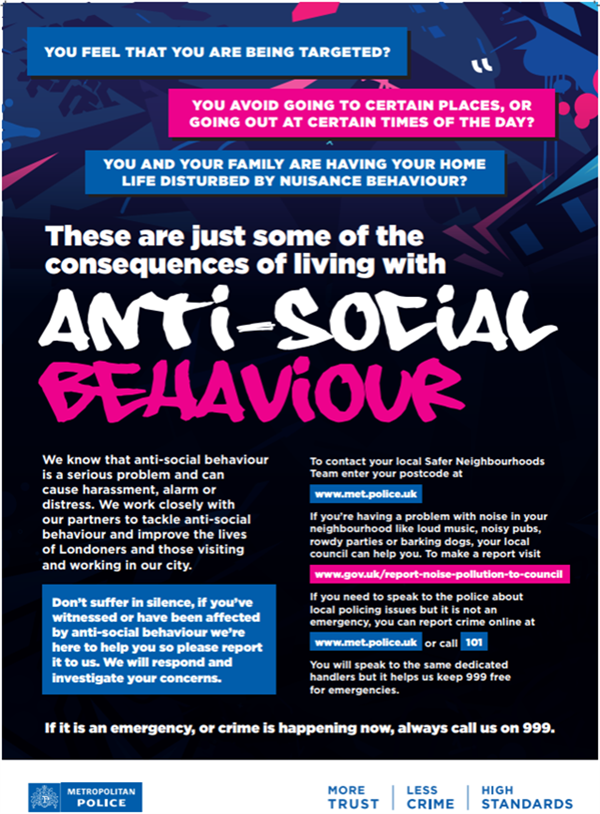 Drug dealing is often linked with violent crime and the exploitation of vulnerable people, and discarded drug equipment can be a health risk and counts as antisocial behaviour. We’ve put hundreds more officers on the frontlines of community crime-fighting teams, upping visible patrols in the right ‘hot spots’ so we can deter and catch criminals. We are committed to tackling drug dealing wherever we find it. It forms a key part of our recently published ASB Action Plan. We will keep you updated on our efforts to do this in your area, but if you have any concerns or evidence, it is important you report this as soon as possible. If you have experienced drug dealing in your area, please report it using our online reporting tools at https://www.met.police.uk or call the non-emergency number 101. Alternatively, you can stay 100% anonymous by contacting the independent charity Crimestoppers on 0800 555 111 or via their untraceable online form at www.crimestoppers-uk.org |