

|
||
|
|
||
|
||
|
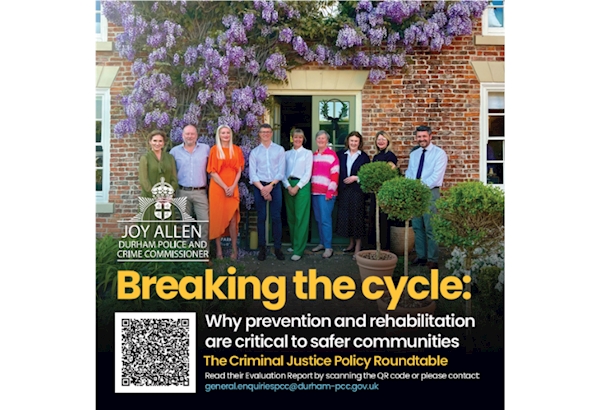
A message from Durham Police and Crime Commissioner, Joy Allen: Breaking the cycle: Why prevention and rehabilitation are critical to safer communities. |
||
|
When I became Police and Crime Commissioner, I made a clear commitment to tackle not only crime itself, but the root causes driving offending, addiction, anti-social behaviour and repeat victimisation. That commitment sits firmly at the heart of my Police, Crime and Justice Plan 2025–2029 and my ambition to build communities that are safer, stronger and more resilient to alcohol and drug-related crime and disorder. It was this determination that led me to establish the Criminal Justice Policy Roundtable, bringing together policing, prisons, probation, health, housing, universities, charities and people with lived experience to confront some of the biggest failings and pressures within our criminal justice system. The Roundtable was never designed to be a talking shop. It was created to challenge outdated thinking, drive practical reform and identify evidence-led solutions that cut crime, reduce reoffending and better protect victims and communities. It was meant to add value to the excellent partnership working that exists around the Local Criminal Justice Board that I Chair. Because the reality is stark: we cannot arrest our way out of addiction. Across the country, courts are overwhelmed, prisons are overcrowded, and reoffending rates remain far too high. Meanwhile, communities continue to suffer the consequences of repeat offending, acquisitive crime, anti-social behaviour, violence and exploitation linked to drugs and alcohol. Behind many offences lie deeper problems, addiction, trauma, mental ill-health, homelessness, domestic abuse and social exclusion. If we fail to address those drivers, we simply trap people in a revolving door of offending, custody and crisis while communities continue to pay the price. The Roundtable examined these issues head-on. One major focus was women in the criminal justice system. Many women who offend are themselves victims of abuse, exploitation and trauma. Short prison sentences often fail to rehabilitate and instead worsen instability, break family ties, and increase the risk of reoffending. The report calls for stronger trauma-informed support, earlier intervention, improved diversion schemes and community-based alternatives that tackle the causes of offending while maintaining accountability and protecting the public. Housing and homelessness were also identified as major drivers of repeat offending.
People leaving prison without stable accommodation are far more likely to relapse into addiction, become involved in crime again or fall into exploitation and rough sleeping. That is why the Roundtable recommended stronger “through-the-gate” support and far better coordination between housing, probation, healthcare and treatment services. The discussions also highlighted the enormous impact addiction has on crime and anti-social behaviour. Around half of acquisitive crime is linked to drugs, while addiction continues to fuel violence, disorder and repeat offending. The Roundtable explored innovative approaches including Drug Testing on Arrest, recovery-focused treatment pathways and diversion schemes designed to break the cycle of addiction and crime before more victims are created. None of this is about being soft on crime. It is about being smarter, tougher and more effective in reducing crime long-term. Every prevented relapse, every avoided reoffence and every person successfully supported into recovery means fewer victims, fewer crimes and safer streets. The Criminal Justice Policy Roundtable was created to drive action, influence national debate and deliver practical change that improves public safety and strengthens communities. And this report is only the beginning. You can read the full Policy Roundtable Evaluation Report and explore the recommendations in more detail by scanning the QR code below or by contacting general.enquiriespcc@durham-pcc.gov.uk
| ||
Reply to this message | ||
|


|