

|
||
|
|
||
|
||
|
E-Bikes/ E-Scooters/ Fun-Bikes |
||
|
Dear Residents, This message is directed to all parents, guardians, and family members of young people who use E-bikes, E-scooters, and fun bikes within the community. South Wales Police has recently been made aware of an incident in the local area in which the rider of a fun bike sustained injuries. In response, the Local Neighbourhood Policing Team (NPT), in partnership with the Neath Port Talbot Road Safety Team, will be carrying out joint visits to speak directly with young people in order to raise awareness of road safety and responsible vehicle use. In addition, we would like to take this opportunity to share important advice and guidance with the wider community, as outlined below.
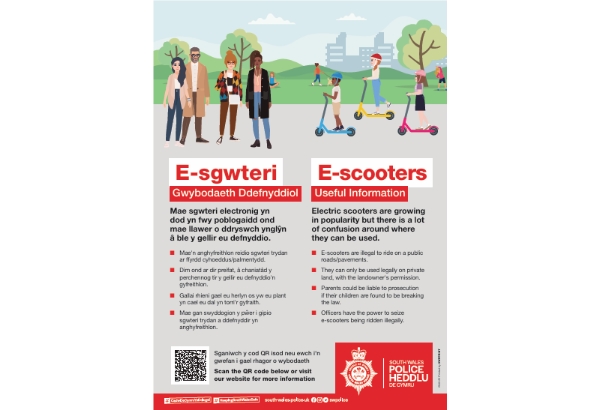
Riding an electric scooter: the rulesIt is illegal to ride a privately owned electric scooter (also known as an ‘e-scooter’) in public, for example on pavements, on roads or in parks. You could be fined and get penalty points on your driving licence. The scooter could also be seized by the police. You can only ride a privately owned electric scooter on private land with the permission of the landowner. There are different rules for using mobility scooters.
Renting an electric scooterYou can only rent an electric scooter through official electric scooter rental schemes in certain areas of the country. These rental schemes are also known as ‘e-scooter trials’ and have their own rules. There are no rental schemes in Wales at this time. You can ride a rented electric scooter on public roads, including cycle lanes. It is illegal to ride a rented electric scooter on a pavement or a motorway.
Who can rent an electric scooterYou must have a full or provisional UK licence. You might be able to use a full driving licence from another country. Check the rules for using your licence in the UK. If you have a provisional driving licence, you do not need to show L plates when you ride an electric scooter. InsuranceThe rental scheme operator will provide third-party motor insurance.
Electrically assisted pedal cycle (EAPC) is the legal term for an e-bike or e-cycle that can be treated the same as a conventional pedal cycle, provided the user is age 14 or over. There are many products known as ‘e-bikes’ or ‘e-cycles’ available on the market. However, not all of these are classified as EAPCs. To be classified as an EAPC under the EAPC regulations, the cycle must: be fitted with pedals that can propel it have an electric motor with a maximum continuous rated power not exceeding 250 watts cut off electrical assistance when it reaches 15.5 miles per hour (mph) EAPCs that comply with the regulations do not need to be registered, insured or taxed (Vehicle Excise Duty). If an EAPC does not comply with the regulations ( as Above), it is treated as a motor vehicle under the Road Traffic Regulation Act 1984 and the Road Traffic Act 1988.
Such vehicles need to be registered, insured and taxed as a motor vehicle. The rider will need an appropriate driving licence and will have to wear an approved motorcycle safety helmet. Motor vehicles first used after January 2016 will need to be type approved or individually approved before they can be registered. Check with the Driver and Vehicle Standards Agency (DVSA) if you think your vehicle was first used before January 2016 and has not been registered.
Power assistance – ‘Twist and Go’Pedal cycles providing electrical assistance without use of the pedals, usually called ‘Twist and Go’. ‘Twist and Go’ cycles are classified as EAPCs provided they meet the EAPC regulations. Under assimilated European law, ‘Twist and Go’ EAPCs placed on the market or entering into service after 1 January 2016 have to meet a range of technical requirements before they can be used on roads. This is typically established by ‘type approval’ at the manufacturing stage. If a ‘Twist and Go’ EAPC has not been ‘type approved’, importers and individuals can apply for a Motorcycle Single Vehicle Approval (MSVA). For MSVA purposes, ‘Twist and Go’ EAPCs fall into the 250W LPM (Low Powered Moped) category. The requirement for approval is for manufacturers, importers or individuals bringing new vehicles to market or when creating a new ‘Twist and Go’ EAPC. ‘Off road’ modeSome electric cycles offer a temporary increase in top speed that is often advertised as ‘off road’ mode. When ‘off road’ mode is activated, the vehicle can be propelled by the motor at a speed greater than 15.5 mph. Vehicles that have this feature do not, in our opinion, comply with the EAPC regulations and are considered motor vehicles. The Pedal Cycles (Construction and Use) Regulations 1983These regulations specify the requirements pedal cycles, including EAPCs, must meet when sold for use or used on a public road[footnote 3]. The main requirements cover brakes and information about the vehicle. BrakesThe brakes must comply with paragraph 4.6.8 of British / European / International standard BS EN ISO 4210-2:2014[footnote 4], or any equivalent European standard and be maintained in efficient working order. EAPC markingEAPCs must be marked with important information either on a plate or on the EAPC itself. If the EAPC has a plate, it must be fitted securely in a clear and accessible position. The plate must show the: manufacturer’s name maximum continuous rated output of the motor nominal voltage of the battery If the EAPC doesn’t have a plate, it should be visibly and durably marked with the: manufacturer’s name maximum continuous rated output of the motor maximum speed at which the motor can propel the vehicle in mph or kilometres per hour (kph) Lights and reflectorsThe Road Vehicle Lighting Regulations set out the requirements for lights and reflectors[footnote 5]. The requirements for EAPCs are the same as for ordinary pedal cycles. Lights and reflectors must be fitted to any EAPC used on a public road between sunset and sunrise. Front and rear lights plus reflectorsA lamp displaying white light must be fitted to the front of the EAPC. It may show a steady light or may flash. A lamp displaying a red light must be fitted to the rear of the EAPC. It may show a steady light or may flash. Flashing lights must flash at a steady rate of between 60 and 240 times per minute and have a minimum intensity of 4 candela. A red reflector must be fitted to the rear of the vehicle. Pedal reflectorsAmber pedal reflectors must be fitted to the front and rear edges of each pedal unless the cycle was manufactured before 1 October 1985. Product safety, design and construction requirementsEAPCs that are not type or individually approved might need to comply with the following legislation on design and construction requirements: the General Product Safety Regulations 2005, as amended the Supply of Machinery Regulations 2008, as amended the Electrical Equipment (Safety) Regulations 2016, as amended the Electromagnetic Compatibility Regulations 2016, as amended It is the responsibility of a business or manufacturer to understand and comply with the regulations that apply to their products and their role in the supply chain. You can get advice from: the Department for Business and Trade Obtaining the regulations and directivesIf you would like a printed copies of the regulations, Statutory Instruments are available to purchase from TSO. Legal informationThis guidance provides general guidance and advice on the legal requirements in Great Britain relating to EAPCs when used on public roads. For information about EAPCs in Northern Ireland, contact the Department for Infrastructure. This guidance is a summary of DfT’s understanding of what the law requires. However, ultimately the interpretation of the law is a matter for the courts based on individual facts of any particular case. You are therefore advised to consult the relevant legislation and, if necessary, seek independent advice. The Electrically Assisted Pedal Cycles Regulations 1983 SI 1983/1168 as amended by the Electrically Assisted Pedal Cycles (Amendment) Regulations 2015 SI 2015/24. ↩ ‘Walk assist’ functionality (where the speed doesn’t go above 3.7 mph) is outside the scope of type approval. ↩ The Pedal Cycles (Construction and Use) Regulations 1983 SI 1983/1176, as amended by the Pedal Cycles (Construction and Use) (Amendment) Regulations 2015 SI 2015/474. ↩ BS EN ISO 4210-2:2014 Cycles. Safety requirements for bicycles. Requirements for city and trekking, young adult, mountain and racing bicycles. ISBN 978 0 580 78278 7. ↩ The Road Vehicle Lighting Regulations 1989 SI 1989/1796, amended by the Road Vehicle Lighting (Amendment) Regulations 2005 SI 2005/2559. ↩ If you own an e-bike or e-scooter or are thinking of purchasing one for yourself or someone else, please take note of this Important Safety Message from the UK’s national product regulator, the Office for Product Safety and Standards (OPSS). E-bikes and e-scooters use large lithium-ion batteries which can present a risk of serious fire or explosion in certain circumstances. While these can be used safely, there have been a number of fire incidents involving lithium-ion batteries in e-bikes and e-scooters, including in conversion kits. OPSS recommends you follow these five steps when purchasing, using or charging your e-bike or e-scooter to reduce fire risks: Step 1: RESEARCH – only BUY an e-bike, e-scooter, charger or battery from a known seller and check any product reviews Step 2: READ – always READ and FOLLOW the manufacturer’s instructions for charging and using e-bikes or e-scooters Step 3: CHECK – not all e-bike or e-scooter batteries and chargers are compatible or safe when used together. Check and only USE the manufacturer’s recommended battery or charger Step 4: CHARGE – always charge in a safe place without blocking exits and always UNPLUG your charger when you have finished charging Step 5: NEVER – attempt to modify or tamper with your battery Graham Russell, Chief Executive of OPSS said: | ||
Reply to this message | ||
|


|