

|
||
|
|
||
|
||
|
‘Hotspot’ policing contributes to decline in ASB and serious violence across Devon and Cornwall |
||
|
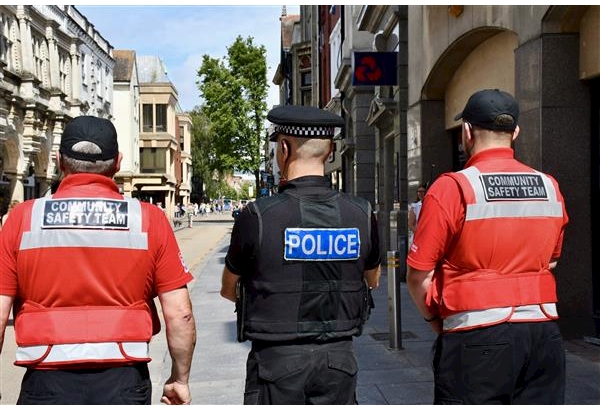
A hotspot patrol in Exeter city centre
A scheme that introduced ‘hotspot’ patrols in 15 locations across Devon and Cornwall to specifically tackle street violence and anti-social behaviour (ASB) has contributed to a significant decline in crime. Additional foot patrols – conducted by police officers and street marshals – were introduced two years ago thanks to Home Office funding secured by Police and Crime Commissioner Alison Hernandez, and additional funds from the Office of the for Devon, Cornwall and the Isles of Scilly. In Camborne, ASB was increasing by 20 per cent each year before hotspot policing but in 2025, the town experienced a fall of 40 per cent. Across all locations, reports of ASB and street violence were down by an average of 10 per cent in 2025, compared with the previous year. The scheme initially began with 13 hotspot areas, but was expanded to 15 last year. Each location was chosen based on statistics that identified them as being more prone to ASB or serious violence. The areas are: Exeter Barnstaple Bideford Exmouth Tiverton Plymouth St Austell Newquay Penzance Truro Bodmin Camborne Newton Abbot Torquay Paignton The original 13 locations saw an average 20 per cent rise in reported anti-social behaviour and street violence between 2022 and 2024. But in 2025, the first full year of hotspot policing, there was a 10 per cent decrease within those same locations. Targeted police patrols, street marshals, outreach work and targeted activity have all formed part of the wider hotspot approach. An important strength of the model is that street marshals – who are equipped with limited police powers granted to them by the Chief Constable under the Community Safety Accreditation Scheme (CSAS) – share real-time information with local authorities and police due to their regular presence on our streets, making them more likely to witness ASB in the act. This enhances the co-ordination and speed of enforcement and prevention, enabling issues to be identified and addressed more effectively. Hotspot policing lead for Devon & Cornwall Police, Inspector Dominic Nicholls, said: “While the positive and tangible change in Camborne is not down to a single intervention in isolation, it is an example of the positive picture that can be seen when visible patrols, police activity and partnership problem-solving are brought together in a focused way.” Police and Crime Commissioner Alison Hernandez added: “The results speak for themselves. The force, my office and our partners delivering the foot patrols have driven down ASB and violence rates. The theory behind the scheme is simple; more uniformed visibility in higher crime areas will deter people from making bad choices in that moment, which is proven, and something our community instinctively knows. “But we are aware there are deeper issues causing individuals to act in a disruptive manner, and those issues require investment from drug and alcohol treatment to housing. “ASB is a scourge on our society and the daily grind of it can significantly impact residents going about their lives or shopkeepers trying to earn a living. I recently announced my funding for street marshals will continue, keeping them as part of our wider policing family for at least the next six months, while we wait for further details of government funding for other, specific street focused projects.” Hotspot policing forms part of a wider Street Focus project, aimed at creating safer city and town centres. For more information visit: www.street-focus.co.uk | ||
Reply to this message | ||
|


|