|
Hello Resident 
Please click here to complete the survey
In early 2026, personal fraud in the UK has reached record levels, driven largely by AI-powered impersonation, synthetic identity fraud, and account takeovers. Fraud now accounts for approximately 45% of all crime in England and Wales. Top Fraud Threats in 2026 AI & Deepfakes: Criminals use AI to clone voices of family members or bank officials to create high-pressure, believable scenarios (e.g., "emergency" funds for relatives).Synthetic Identity Fraud: Fraudsters combine real and fabricated data to create "Frankenstein" identities, which they use to build long-term credit before "busting out" with large loans.Account & SIM Takeovers: Unauthorised SIM swaps increased by 38% in 2025, allowing criminals to bypass two-factor authentication (2FA) and take over bank and telecom accounts.Investment & Crypto Scams: Victims are lured by exceptional returns on fake crypto platforms. Small initial "wins" build trust before the fraudster disappears with large transfers. Prevention Checklist: "Stop, Challenge, Protect" The UK's national Stop! Think Fraud campaign and West Midlands Police recommend three core steps: Step | Action |
|---|
| 1. Stop | Take a moment to pause. Criminals use false urgency to rush you into making a mistake. | | 2. Challenge | Could it be fake? Reject or ignore any request for money or data. Banks and Police will never ask for your PIN or for you to move money to a "safe account". | | 3. Protect | If you think you've been targeted, contact your bank immediately and report it to Report Fraud (or call 0300 123 2040). |
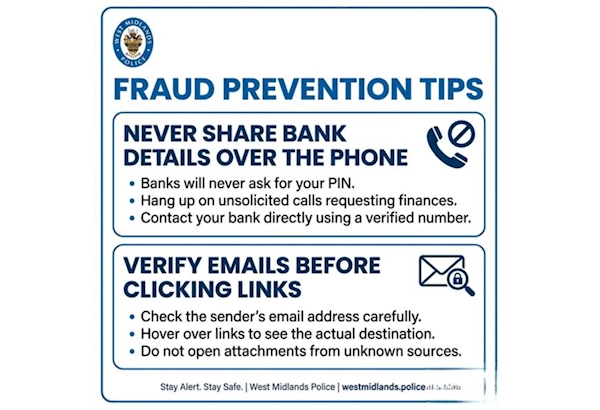
Security Tips for 2026 Verify Contact: Never use numbers or links provided in a text or email. Call your bank using the number on the back of your card or by dialling 159.Strong Passwords: Use a combination of three random words (e.g., fishbooktable) and unique passwords for every account to prevent "credential stuffing" attacks.Enable 2FA: Turn on two-factor authentication for all sensitive accounts (email, banking, social media) to add a layer of security even if your password is stolen.Check the FCA Register: Before making any investment, verify the firm is officially authorised on the Financial Conduct Authority (FCA) Register.Social Media Hygiene: Avoid oversharing personal details (like birth dates or locations) that scammers can use for "spear-phishing" or identity theft. Ten golden rules to prevent fraud Remember these ten golden rules to help you prevent fraud and beat the scammers. Be suspicious of all ‘too good to be true’ offers and deals. There are no guaranteed get-rich-quick schemes.Don’t agree to offers or deals immediately. Insist on time to get independent or legal advice before making a decision.Don’t hand over money or sign anything until you’ve checked someone’s credentials and their company’s.Never send money to anyone you don’t know or trust, whether in the UK or abroad, or use methods of payment you’re not comfortable with.Never give banking or personal details to anyone you don’t know or trust. This information is valuable so make sure you protect it.Always log on to a website directly rather than clicking on links in an email.Don’t just rely on glowing testimonials. Find solid, independent evidence of a company’s success.Always get independent or legal advice if an offer involves money, time or commitment.If you spot a scam or have been scammed, report it and get help.Don’t be embarrassed about reporting a scam. Because the scammers are cunning and clever there’s no shame in being deceived. By reporting it, you'll make it more difficult for them to deceive others.Thank you |