

|
||
|
|
||
|
||
|
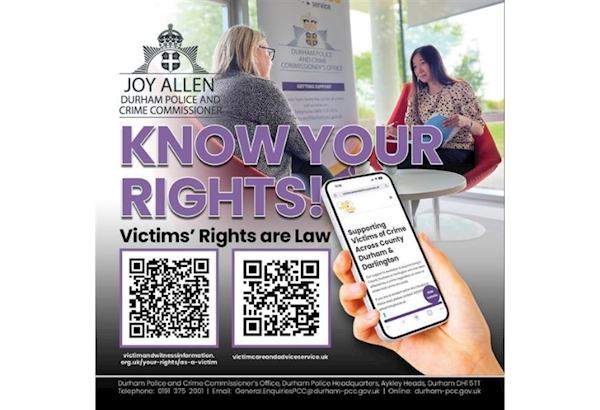
An update from Durham Police and Crime Commissioner: Victims’ Rights Are Law... know your rights! |
||
|
We say we are tough on crime. But being tough on crime must also mean standing up for victims. Because victims in this country have legal rights. Not aspirations. Not guidance. Rights. Yet too many people do not know what those rights are, and too many do not experience them in practice. When victims feel ignored, uninformed or unsupported, justice itself is weakened. Under the Victims’ Code, every victim of crime is entitled to: • The right to have the crime recorded promptly — You should be taken seriously from the outset and not left in doubt that action is being taken. • The right to clear information from the start — You must be told what will happen next, how the system works and where to get help. • The right to be kept informed — You should receive updates about your case and be told about key decisions without chasing for answers. • The right to tailored support services — You can be referred to free, confidential support based on your individual needs. • The right to make a Victim Personal Statement — You can explain in your own words how the crime has affected your life. • The right to know about court hearings and outcomes — You should be told what is happening and what the result means. • The right to request a review — If a case is not progressed, you can ask for that decision to be reconsidered. • The right to complain if standards are not met — If agencies fail to deliver your rights, you can challenge that failure. These are legal entitlements designed to protect dignity, voice and fairness. But rights that are unknown go unused. And rights that are not delivered undermine confidence in the justice system. As Police and Crime Commissioner, I see it as my responsibility not only to promote these rights, but to enforce them through leadership and accountability. In my Police, Crime and Justice Plan 2025–2029, I committed to delivering a first-class service to victims. That means ensuring agencies adhere to the Victims’ Code, implementing robust monitoring of compliance, and making sure the Victims and Prisoners Act 2024 is reflected in local practice, not just policy documents. It means embedding trauma-informed approaches in policing and commissioned services so victims are treated with care, not processed through a system. It means strengthening our Victim Care and Advice Service under direct oversight of my office to improve accountability and partnership working. It means amplifying lived experience through my Victims’ Champions and advisory engagement so victims’ voices are heard when policies are shaped. It means scrutinising victim attrition, the cases that collapse because victims feel disengaged, and challenging partners to improve communication, safeguarding and support. As Chair of the Local Criminal Justice Board, I am pressing agencies to tackle court delays, improve data collection on victim experience and ensure consistent delivery of rights across the system. Because when victims lose confidence, fewer crimes are reported. When fewer crimes are reported, offenders evade justice. And when offenders evade justice, communities are less safe. This is not about rhetoric. It is about raising standards. Victims deserve to understand their rights in plain English. They deserve those rights delivered consistently. They deserve a system that listens, learns and improves. In County Durham and Darlington, I will continue to champion victims, hold agencies to account and demand that legal rights translate into real-world experience. Victims are not an afterthought in our justice system. They are being put front and centre by both the Chief Constable and myself, where they deserve to be!
| ||
Reply to this message | ||
|


|