

|
||
|
|
||
|
||
|
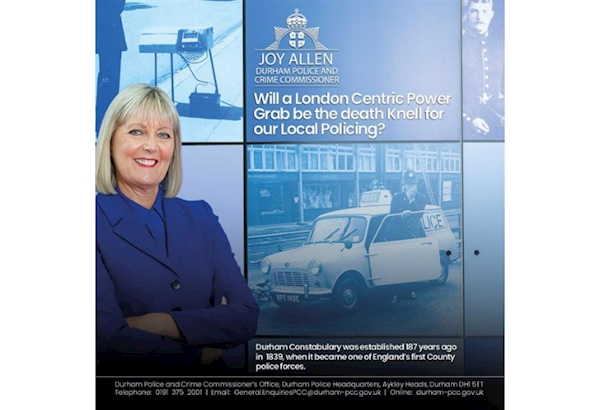
A message from Durham Police and Crime Commissioner... Police Mergers – Will a London Centric Power Grab be the death Knell for Local Policing! |
||
|
Durham Constabulary was established 187 years ago in 1839, when it became one of England’s first county police forces. Its boundaries ones included Hartlepool, Sunderland, Gateshead, and South Shields. These boundaries changed in the 1970s, when parts of the county became part of Northumbria and Cleveland. But those changes followed legislation, scrutiny, and public debate in recognition that policing is about place, identity, and trust. To date there has been no consultation whatsoever on these proposals, apart from lots of column inches given the opinions of London based Metropolitan Police Commissioner and the Chair of National Police Chief Council, no published research, no impact assessment, and no sense that the public has been asked what they think of creating large centrally controlled forces. This matters because policing does not belong to politicians, civil servants, or police chiefs. It belongs to the public. People experience policing not through strategies or structures, but through whether an officer turns up when they call, whether local problems are understood, and whether someone is accountable when things go wrong. Local policing works because it is local. Officers know their patch. Leaders understand the difference between a policing a city, a market town, and a rural village. Communities know who is responsible and how to raise concerns. That connection is important, and once weakened, it is extremely hard to rebuild. Supporters of force mergers argue that crime does not respect borders. That is true, and it always has been. But police forces already work together across borders every day. Serious and organised crime is tackled jointly. Intelligence is shared. Collaboration exists without dismantling local policing or erasing local identity. We should also challenge the assumption that bigger automatically means better or saves money. Some of the largest police forces in the country, Greater Manchester, the West Midlands, Nottinghamshire, and the Metropolitan Police have all, at some point, been placed into special measures because they were failing. Size did not protect them. In some cases, it made problems harder to spot, harder to manage and harder to fix. Large organisations can become distant, complex, and difficult to control. Here in the North East, these options are already being talked about. Should Durham remain as it is, reflecting its mix of urban, town and rural communities? Should Durham merge with Northumbria, while Darlington aligns with Cleveland to reflect North East and Tees Valley footprints? Or should local oversight be replaced by a regional board represented by mayoral areas? Each option would have far-reaching consequences for how policing feels on the ground. Yet ordinary people have not been asked what they think about any of these options. British policing is built on a simple but powerful idea set out nearly two hundred years ago by Sir Robert Peel: the police are the public, and the public are the police. That principle only works when policing is shaped with public consent. Yes, policing must evolve. Chiefs will argue for radical change to meet modern challenges. But radical change imposed from above, without evidence and without public involvement, breaks the very bond that policing depends on. Change must be done with communities, not to them. This decision is too big, too important, and too far-reaching to be cobbled together behind closed doors. The public deserve a say in the future of their local policing, and I will do my upmost to ensure they do!
| ||
Reply to this message | ||
|


|